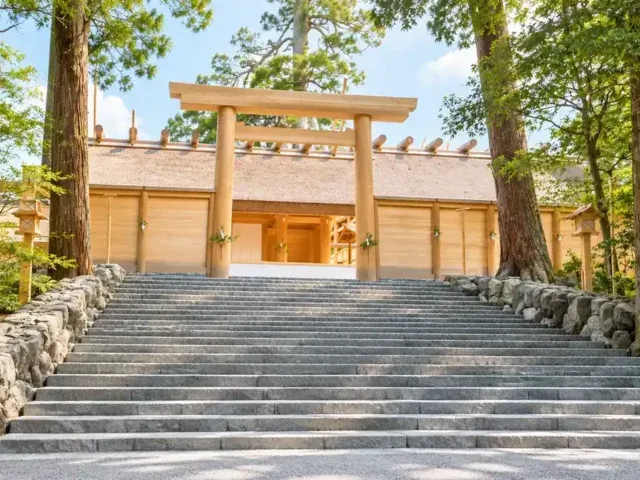
Itsukushima Shrine
Miyajima-cho, Hatsukaichi, Hiroshima Prefecture, Japan Shinto
UNESCO-listed sea shrine on sacred Miyajima, internationally famous for its offshore torii gate.
出雲大社 · Izumo Oyashiro · Izumo Grand Shrine
One of Japan’s oldest and most important Shinto shrines, associated with Okuninushi and traditions of divine gathering and matchmaking.
Sacred Place Overview
Identity, documented context and sacred significance.
Izumo Taisha, officially Izumo Oyashiro, stands at Taisha in Izumo, Shimane Prefecture and is one of Japan’s most important Shinto shrines. Its principal kami is Okuninushi no Kami, a deity prominent in Japan’s earliest mythological records and closely associated today with en-musubi, the forming of beneficial human relationships.
The exact date of the shrine’s foundation is unknown, but Izumo Oyashiro is mentioned in early eighth-century texts including the Kojiki, Nihon Shoki and Izumo no Kuni Fudoki. The present Honden, or main sanctuary, dates from a rebuilding completed in 1744 and is designated a National Treasure. It is a major example of taisha-zukuri shrine architecture.
The shrine’s famous tradition holds that deities from across Japan gather in Izumo during the tenth lunar month; this should be understood as living religious tradition, not a historically verifiable event. Worship customs are distinctive: at the main precinct, visitors traditionally perform two bows, four claps and one final bow.
The sanctuary remains an active place of prayer as well as a major heritage site, and visitors can also see auxiliary shrines and the large sacred ropes associated with the complex.
A concise view of the place, tradition, location and heritage details available for this Sacred Place.
Religious tradition, dedication and sacred associations connected with this place.
Documented history, sacred narrative and editorial synthesis are kept visibly separate.
The shrine is mentioned in Japan’s early mytho-historical texts, including the Kojiki. The current main sanctuary was completed in 1744.
Tradition holds that deities from across Japan gather at Izumo during the tenth lunar month for divine deliberations and en-musubi. This is presented as sacred tradition rather than verified historical fact.
Significance: A major national pilgrimage shrine and one of the central sacred places of Japanese mythology.
Taisha-zukuri · Main sanctuary designated National Treasure of Japan
Monumental traditional shrine architecture; the current main sanctuary dates from the 18th century.
Documented worship, observances and practices where available.
Practical access information and visitor guidance for this Sacred Place.
Road, rail, air and local-access information where documented.
Travel tips: Respect the shrine’s distinctive prayer custom of two bows, four claps, one bow|Check festival dates before travel
Crowds: Especially busy during Kamiari season and New Year.
Continue exploring places connected by tradition, geography, architecture, heritage or pilgrimage.
UNESCO-listed sea shrine on sacred Miyajima, internationally famous for its offshore torii gate.
One of the three Kumano Sanzan grand shrines and a central destination of the Kumano Kodo pilgrimage.
Japan’s most sacred Shinto sanctuary, dedicated to Amaterasu Omikami and central to the Ise pilgrimage tradition.
Tokyo’s major imperial Shinto shrine, set within a vast man-made forest beside Harajuku.
Found outdated or incorrect information? Send a factual correction for editorial review.
Transparency